
August 24, 2026 · Joe Molina
Can electric cars go through a car wash? A South Bay driver's guide
Yes, most EVs can use a car wash. Learn the mode, neutral, charge-port, and wiper checks South Bay electric-car drivers should know.
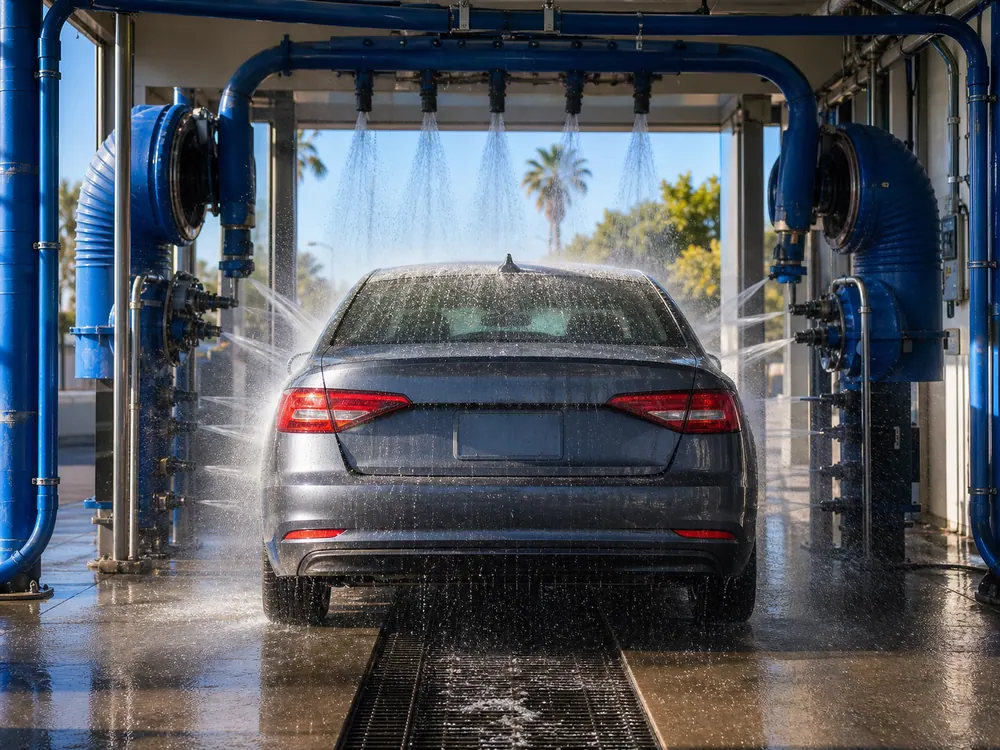
The marine layer has dried into a pale film, the camera view is fuzzy, and there is Hermosa Beach sand in the footwells. The car happens to be electric. Does that change where you can wash it?
Usually, it does not. Electric cars can go through a car wash in most cases. The battery is built for normal wet-weather driving, and manufacturers publish car-wash instructions for their EVs. The part that deserves attention is the setup: automatic wipers, electronic parking brakes, flush door handles, charge-port doors, and software-controlled Neutral can all behave differently from one model to another.
Think of it as a 30-second handoff problem, not a water-and-battery problem.
The water is ordinary; the controls are the wrinkle
An electric car does not need a special soap because it has a battery. It still collects road film on Torrance Boulevard, salt haze near the Redondo Beach waterfront, pollen in North Redondo, and bug residue on the drive home.
Automakers would not include automatic-wash procedures if normal car-wash water were off limits. Tesla’s current Model 3 owner’s manual includes Car Wash Mode and free-roll directions. Polestar’s automatic-wash guidance explains how its cars should be set for different wash layouts.
There are exceptions. A manufacturer may allow only certain automatic equipment, while a damaged charge-port door, loose trim, active electrical warning, fresh paint repair, matte finish, wrap, or aftermarket accessory may carry its own restrictions. Those are reasons to read the manual or call the installer before washing. They are not reasons to assume every EV must stay dry.
Two wash layouts ask the car to behave differently
The most useful question at the entrance is not “Is my car electric?” It is “Will the car’s wheels move during this wash?”
In a conveyor or tunnel, equipment moves the vehicle forward. The wheels need to roll, so many EVs require Neutral, a dedicated free-roll setting, or a specific car-wash sequence. Electronic parking brakes and automatic hold features cannot be allowed to re-engage halfway through.
In a rollover or in-bay setup, the vehicle stays put while the equipment moves around it. That layout may call for Park instead. Polestar, for example, gives separate Neutral and Park instructions for those two situations.
Do not guess from the building. Read the posted directions and tell the attendant if selecting Neutral on your car requires a touchscreen sequence. Finding that control while the line is moving is much harder than finding it in the driveway.
Do the software homework before joining the line
Car Wash Mode is a bundle of small settings. Depending on the model, it may close windows, lock the charge port, disable rain-sensing wipers, fold mirrors, silence parking alerts, or keep the car able to roll.
For a Tesla, the owner’s manual currently directs drivers to Controls > Service > Car Wash Mode. If a conveyor needs the car to move freely, Enable Free Roll is a separate step. Other brands use different names and menus, and some EVs have no dedicated mode at all.
Look up the procedure for your exact model and model year before leaving home. Then practice reaching the screen or shifter once while safely parked. A saved screenshot can help, but the live owner’s manual should outrank an old social post because software menus can change.
That preparation is especially useful for a new EV owner driving over from Torrance or Manhattan Beach. You can talk to the crew about the wash instead of trying to learn the car’s controls at the entrance.
Give the crew a clean handoff
Use this quick check before the wash begins:
- Finish charging and close the charge-port door completely. Do the same for the trunk, frunk, windows, and sunroof.
- Remove loose exterior gear. Temporary signs, roof-rack accessories, damaged trim, and anything held on by a weak magnet need attention.
- Turn off automatic wipers. A wet windshield can wake them up at the wrong time if car-wash mode does not handle this for you.
- Set mirrors, handles, locks, and driver-assistance features as the manual directs. Do not assume every model wants its mirrors folded or doors unlocked.
- Tell the attendant how the car enters Neutral or free roll. Mention any unusual screen sequence before the vehicle needs to move.
- Follow the operator’s signals. The vehicle manual explains the car; the crew explains the equipment. You need both halves.
Afterward, confirm that normal drive settings have returned before entering traffic. Check the instrument display, unfold anything the manual says to restore, and make sure the charge door is still secure.
Beach grime does not care what powers the wheels
An EV parked near the water gets the same coastal buildup as any other daily driver. A weekend near the Hermosa Pier can leave sand below the seats. Manhattan Beach parking adds dust around the rear hatch and camera. Ocean air settles on glass and paint in Redondo Beach, while a Torrance commute adds lower-panel road film.
The difference is where some EVs make that grime obvious. Smooth front ends show bug marks quickly. Cameras and sensor covers reveal a thin film as a blurry image or temporary obstruction warning. Flush handles and the edge of a charge-port door can hold a narrow dirt line even after the broad panels look clean.
Pick the service by the mess, not the powertrain. An exterior reset may be enough for road film and coastal haze; compare the current wash packages. If beach sand has crossed the door line, a full-service wash adds vacuuming and an interior wipe. Stains or embedded cabin grime belong on the detail menu, whether the car runs on electricity or gasoline.
Drivers coming from Hermosa Beach, North Redondo Beach, and the rest of the South Bay do not need an “EV soap.” They need the correct vehicle settings and a wash that matches where the dirt landed.
Pull in with the right mode already found
Before your first electric-car wash, spend two minutes with the owner’s manual. Identify car-wash mode if the vehicle has one, learn how Neutral or free roll works, and check any finish-specific restrictions. At the wash, ask whether the car will roll or remain parked and give the crew the relevant controls before the equipment starts.
Redondo Car Wash is at 617 Torrance Blvd. Tell the crew you brought an EV and what its manual requires. Once the handoff is clear, the job is familiar: sand, salt film, road grime—handled fast.
Up next
First time here? Unlock your free wash.
Built for sandy South Bay cars, clear prices, and no membership games.
Keep reading
More from the blog
Oct 2026
When can you wash your car after a windshield replacement? A South Bay timing guide
Got a new windshield? Learn when a car wash is safe, what the first 24 hours protect, and how South Bay drivers can avoid stressing the new seal.
Oct 2026
Car wash after LAX parking: what South Bay drivers should clean first
Back from LAX? Check airport dust, bird marks, luggage grit, and cabin mess, then choose the right South Bay wash for the drive home.
Sep 2026
Car cleaning after soccer practice: a South Bay parent's game plan
Keep mud, turf pellets, grass, and damp gear from taking over your car after soccer practice with a practical South Bay cleanup routine.