
July 2, 2026 · Joe Molina
Hand-dry car wash in Redondo Beach: why the final wipe matters near the beach
A hand-dry finish catches coastal drips, glass haze, and trim spots that beach-area cars leave behind after the rinse.
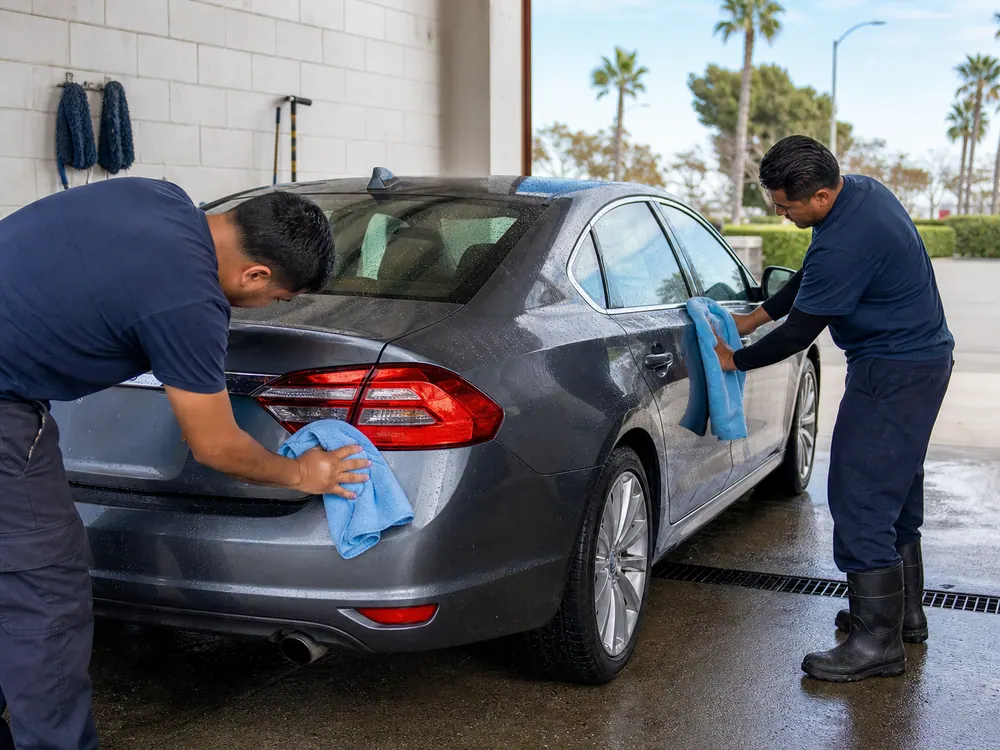
You can leave a wash on Torrance Blvd with the paint looking clean, hit a couple red lights, and suddenly notice a drip line sneaking out from the mirror cap or hatch seam.
That is a beach-car problem, not a soap problem.
Around Redondo Beach, Hermosa Beach, Manhattan Beach, and the western side of Torrance, the rinse is only half the battle. Ocean air, damp mornings, and sandy lower panels make cars hold onto water in small places. That is why a hand dry car wash in Redondo Beach matters more here than it does farther inland. The final wipe is what makes the car actually look finished when you pull back into the sun.
Coastal cars stay wet in all the wrong places
Near the beach, the car does not dry evenly.
Salt film leaves the surface a little grabby. Marine-layer moisture keeps trim and glass cooler longer. Lower panels collect road grime that traps water instead of letting it sheet away cleanly. Even after a good wash, the car can still be hiding little wet pockets that show up ten minutes later.
That is why local cars often re-spot in the same places:
- mirror housings
- window trim
- license-plate recesses
- hatch and trunk seams
- lower door edges
- wheels and tire shoulders
Drivers coming over from Hermosa Beach or Manhattan Beach usually notice it on the glass first. Cars coming from Torrance or North Redondo Beach often notice it on the lower half after a week of commuting, errands, and open-lot parking.
Hand-drying fixes the spots blowers usually leave behind
A blower handles the obvious water. Hand-drying handles the details that make a clean car look sharp instead of half-finished.
Mirrors, trim, and badges
These are the classic coastal drip points. Water hides behind mirror caps, along weatherstripping, and around badges. Once the car hits daylight, those little leftovers run out and leave narrow streaks on otherwise clean paint.
Near the beach, those streaks look worse because the leftover moisture is mixing with light salt residue instead of plain dust.
Glass edges and windshield corners
South Bay windshields haze up fast. A rushed dry leaves the corners, top edge, and side-glass line looking cloudy again by the next sunset drive. That matters more than people expect. The car can feel freshly washed at noon and still look tired when you head west in late-afternoon glare.
Hatch seams, lower panels, and wheel faces
This is the area most people miss at home. Water hangs around the hatch lip, rear bumper corners, rocker panels, and wheel openings because those spots are already carrying sand, brake dust, and traffic film. A hand-dry finish catches the leftover moisture before it turns into gray streaking down the lower half of the car.
The difference shows fastest on dark paint and busy daily drivers
Black, navy, charcoal, and deep gray paint tell on a rushed dry immediately. So do cars that spend all day being looked at up close.
That includes:
- commuter cars parked outside near the coast
- rideshare and client-facing cars
- family SUVs doing the school-and-beach loop
- newer cars people are actively trying to keep nice
If the car lives in the South Bay, it does not need to be filthy to look unfinished. One damp night, one beach lot, and one quick rinse can be enough to leave marks around the edges.
This is also why the hand-dry conversation is not only about shine. It is about visibility. A proper finish makes it easier to spot what the car actually needs next. If the glass still looks dull after drying, that tells you something. If the paint feels rough while the towel passes over it, that tells you something too.
Full-service is worth it when the mess crossed the door line
Hand-drying helps the outside. It does not fix sandy mats, sticky cup holders, or sunscreen on the armrest.
If the cabin joined the problem, step up to one of the wash packages instead of treating the car like it only needs an exterior reset. That is usually the right move after beach weekends, kid-heavy errands, or any stretch where the inside and outside both took the hit.
Move up again to the detail menu when the car has gone beyond normal maintenance:
- glass stays hazy after cleaning
- paint feels rough instead of smooth
- trim still looks chalky
- interior sand is packed into seams or seat rails
- the whole car looks cleaner, but not actually clean
That progression is what keeps people from overspending on the easy days and undershooting the harder ones.
A simple local rule: judge the finish ten minutes after the wash
The best way to tell whether the dry was good is not while the car is still in the bay.
Judge it after ten minutes in open air.
If fresh streaks are running from the mirrors, the hatch, or the lower panels by then, the job was only partly finished. If the windshield already looks cloudy again when the light hits it, the final dry did not really close the loop.
For South Bay cars, that ten-minute test is more useful than staring at the hood while everything is still wet.
It also helps you choose the right kind of visit next time:
- Outside still looks good, but water keeps hiding in the same places: keep the wash, prioritize the dry.
- Outside and inside both slip backward after beach use: go full-service.
- The finish never quite rebounds, even after a solid wash: move to detailing.
Conclusion
Near the beach, a clean rinse is not the same thing as a finished car.
A hand-dry finish matters because coastal moisture likes to linger exactly where drivers notice it later: on the glass, around the trim, and down the lower half of the vehicle. Catching those spots early keeps the car looking cleaner between visits and makes regular maintenance go further.
If your car lives somewhere between Redondo Beach, Hermosa Beach, Manhattan Beach, and Torrance, the final wipe is not fluff. It is the part that keeps the wash from unraveling on the drive home. Compare the wash packages, check the contact page if you want help choosing the right reset, or stop by 617 Torrance Blvd before the next beach week stacks another layer on top.
Up next
First time here? Unlock your free wash.
Built for sandy South Bay cars, clear prices, and no membership games.
Keep reading
More from the blog
Oct 2026
When can you wash your car after a windshield replacement? A South Bay timing guide
Got a new windshield? Learn when a car wash is safe, what the first 24 hours protect, and how South Bay drivers can avoid stressing the new seal.
Oct 2026
Car wash after LAX parking: what South Bay drivers should clean first
Back from LAX? Check airport dust, bird marks, luggage grit, and cabin mess, then choose the right South Bay wash for the drive home.
Sep 2026
Car cleaning after soccer practice: a South Bay parent's game plan
Keep mud, turf pellets, grass, and damp gear from taking over your car after soccer practice with a practical South Bay cleanup routine.