
September 7, 2026 · Joe Molina
Orange spots on white car paint: what South Bay drivers should check
Tiny orange specks on white paint may be surface iron, not body rust. Learn what South Bay drivers should check and when detailing helps.
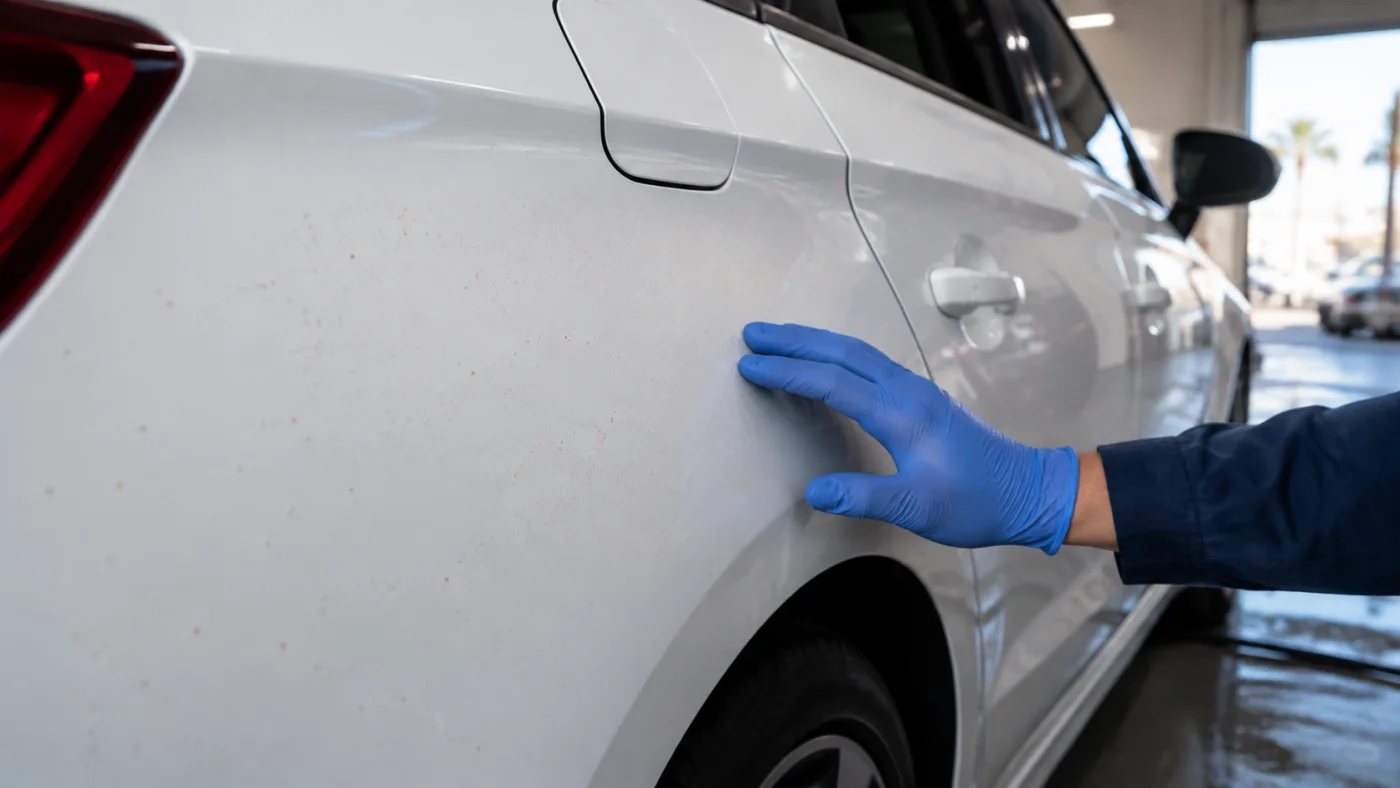
You wash a white car, step back, and see tiny orange dots still scattered across the lower doors and rear quarter panel. They look like miniature rust spots, but the paint around them is smooth and intact.
That pattern is worth checking before you scrub, polish, or buy touch-up paint. Some orange spots on white car paint are iron-containing particles sitting on the clear coat, not rust coming through the body panel. Other marks really do begin at a chip, seam, or paint failure and need a different kind of help.
South Bay driving gives both problems plenty of places to hide. Brake dust, road debris, outdoor parking, damp coastal mornings, and bright afternoon light can turn a few pinhead marks into a very noticeable problem on a white daily driver.
Give each spot a sixty-second triage
Orange alone does not diagnose the spot. Where it appears and what the surrounding paint looks like tell you more.
| What you see | What it may mean | Best next move |
|---|---|---|
| Many pinhead dots on smooth, intact paint | Bonded surface contamination | Wash, dry, then inspect for decontamination |
| One orange center inside a visible chip | Exposed material or corrosion at damaged paint | Ask a body shop or dealer to inspect it |
| Bubbling, lifting, or swelling near a seam | A problem below the paint surface | Stop cleaning experiments and seek paint repair |
Surface contamination often shows up as many tiny specks across intact paint. Look low on the doors, behind the wheels, around the rear bumper, and on the hatch. Those are the areas that live closest to road spray and airborne brake material.
Do not pick at a suspicious mark to find out which row it belongs in. Photograph the area, wash the car properly, and inspect it again when dry. A contaminant on top of clear coat and corrosion below damaged paint may share a color, but they are not the same repair.
White paint acts like a high-contrast warning panel
White paint is not necessarily collecting a special kind of dirt. It simply gives orange and brown specks a high-contrast background. The same fallout can be much harder to notice on gray, blue, or black paint.
That is why owners often spot the issue in a grocery lot or driveway after the car has already been cleaned. Direct sun catches the dots that road film had hidden. A hand passed gently over a washed, dry panel may also notice roughness, but do not keep rubbing a gritty area as a test.
Visibility and severity are different things. A white car may reveal a light surface problem early. That is an advantage if you use the clean paint as a prompt to inspect instead of assuming the body is rusting through.
Read the car from the rear wheel forward
A car does not need to travel by train to collect what people casually call “rail dust.” Iron-containing fallout can come from several sources. Meguiar’s describes automotive iron contamination as including embedded iron particles, industrial fallout, and rail dust.
Around Redondo Beach, the location of the spots can reflect the car’s week. Stop-and-go driving through Torrance puts brake material and road film near the lower half. A windy parking day in Hermosa Beach or Manhattan Beach can add fine dust. Outdoor parking in North Redondo Beach gives that mixture damp mornings and sunny dry-outs.
Coastal moisture does not prove the specks are iron, and beach sand is not automatically the cause. It can make existing surface residue easier to see and gives drivers another reason not to attack a dry panel with a towel. Many fine dots on intact lower paint point in a different direction than one expanding mark at a damaged edge.
Use one wash as a diagnostic reset
Do not diagnose a dirty car. Loose brake dust, tar, bugs, sprinkler residue, and ordinary traffic film can overlap on the same panel.
Start with a proper wash that lifts loose material without a dry scrub. Ford’s current vehicle-care guidance recommends regular washing with cool or lukewarm water and a neutral-pH shampoo, and it specifically calls for removing industrial fallout and other deposits from paint rather than leaving them in place (Ford owner guidance).
After the car is completely dry, check three things:
- Did the spots disappear? They were likely loose surface grime.
- Are tiny specks still sitting on intact paint? Bonded contamination is possible.
- Is the finish broken, raised, peeling, or bubbling? Stop treating it like a cleaning problem.
An exterior option from the wash packages can create that clean baseline. If the car also has dusty sills, sandy mats, or a used-up family interior, full-service handles the inside at the same stop.
Bonded specks call for a different service
Repeatedly washing the same bonded dots will not necessarily move them. Scraping with a fingernail, using a kitchen abrasive, or reaching for an unknown acid can turn a small surface issue into damaged clear coat.
Paint decontamination is the next category when the panel is clean, the finish is intact, and the specks remain. The exact process depends on the paint, contamination, prior repairs, wrap or coating, and the products being used. An iron-removal chemical and a clay treatment are also not interchangeable in every case. Both need correct lubrication, timing, surface temperature, and follow-up protection.
That is where the detail menu is more relevant than another routine wash. Ask for an inspection before assuming every orange dot can be removed. Drivers coming from Torrance can see the same lower-panel pattern as cars parked near Hermosa Beach or Manhattan Beach; the condition of the paint still decides the service.
Bring three facts, not a diagnosis
Tiny orange dots on a white car are a reason to look closer, not a reason to panic or start sanding.
Wash the vehicle, let it dry, and read the pattern. Scattered specks sitting on smooth clear coat may be a decontamination job. A chip, bubble, peeling edge, or exposed metal belongs with a body shop or dealer because a car wash cannot repair paint failure or corrosion.
If the marks survived a normal wash, note three facts: where they cluster, whether the surface feels intact, and whether any paint is missing. Then bring the clean vehicle by Redondo Car Wash at 617 Torrance Blvd. Those details make it much easier to decide whether the next stop is detailing or paint repair somewhere else.
Up next
First time here? Unlock your free wash.
Built for sandy South Bay cars, clear prices, and no membership games.
Keep reading
More from the blog
Sep 2026
How to protect leather car seats from sun in the South Bay
South Bay sun, sand, and wet beach gear can age leather seats. Learn a practical care routine and when interior detailing helps.
Sep 2026
Can matte paint go through a car wash? A South Bay finish check
Can matte paint go through a car wash? Learn how factory paint, wraps, wax, brushes, and South Bay grime change the safest answer.
Sep 2026
Can a convertible go through a car wash? A South Bay roof-check guide
Can a convertible go through a car wash? See how roof type, owner-manual rules, seals, and wash equipment change the answer in the South Bay.